
Botswana Water Transfer Project Abandons Injured Worker
A worker employed as a guard on a construction site is demanding compensation for loss of livelihood after he was injured at work. The South African company that was employing him as a guard on the Lesotho-Botswana Water Transfer Project in Tsinyane, Malealea, has refused to acknowledge responsibility saying that he did not get injured at work. But, they do not seem to have the full details, not even the correct date of the injury.
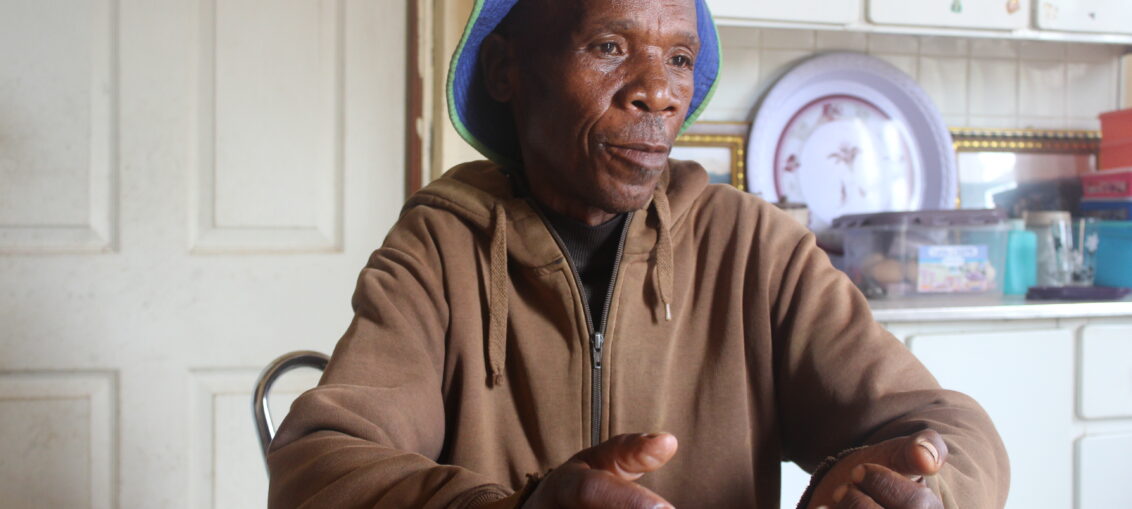
Seabata Monare (62) was hired by Geomechanics, which prides itself on being a leader in geotechnical investigations in Southern Africa, as a guard on the site being prepared for the Makhaleng Dam.
In order to conduct feasibility studies prior to the construction of the Makhaleng Dam, which is intended to export water to South Africa, Botswana, and Lesotho, the Orange-Senqu River Commission (ORASECOM) hired Geomechanics to perform packer tests, piezometer installation, and rotary core drilling in Tsinyane.
Monare lives in the area earmarked for a dam. He told MNN Centre for Investigative Journalism that he was left disabled and unable to fend for himself after the injury he sustained while working at the Geomechanics site, along the Makhaleng river’s gravel surface.
Monare’s medical records from July 22 2023 show that Malealea Clinic referred him to Mafeteng District Hospital where an x-ray was done, which diagnosed a fracture on his right hand and wrist.
A cast was applied for six weeks but when he went for his check-up, the doctor ordered that the cast remain because his fracture had not healed enough. Another x-ray was requested and it detected yet again poor healing and the cast had to be re-applied for another six weeks.
The cast eventually came off on its own, but Monare’s hand was never the same again. The aftermath of the accident has left Monare unable to continue his farming, his primary source of livelihood, plunging him and his family into food insufficiency.
Monare’s account is supported by three people, one also a guard who witnessed the incident and was with him at the time and another colleague who worked the night shift. A local councillor has also stated that she discovered Monare at the scene during routine inspections and inquired about his injuries.
Responding to MNN questions, Laura-Lee Rijsmus who is the Accounts and Marketing Director for Geogroup, which is Geomechanics’ parent company, insists that Monare arrived at work already injured. She distanced the company from any wrongdoing.
“There is a possibility of bias from an eyewitness who knows Monare”, said Rijsmus who does leave room for the possibility that Geomechanics could be accountable for Monare’s injury saying that the eyewitness accounts shouldn’t be dismissed entirely.
For them to conclude this matter, she says they would need “…a written statement from the witness detailing what they saw and see how the witness’s story aligns with Monare’s and any other available information.”
MNN declined to facilitate this process as it understands it is the responsibility of the company to acquire such statements from its former employees.
Speaking to MNN, Teboho Mokala, the eyewitness who was on the same shift with Monare making them the only two people who were on the site when the injury occurred, said he was not entirely shocked that Geomechanics was now claiming innocence.
“The manner in which the whole situation was handled left a lot to be desired,” he said.
Mokala and Monare’s both said during separate interviews that: “It was clear that they were trying to avoid taking responsibility.”
Monare, Mokala and another colleague Keresemese Mokala who worked the night shift were appalled at the insinuation that Monare did not get injured onsite. Mokala [Teboho] told MNN that he arrived for work with Monare that fateful day and he was still fine.
Nthabiseng Tlaleane, a local government councillor in Malealea at the time said she encountered Monare’s injury when she went to inspect work onsite. She says she noticed Monare’s casted hand and asked him what happened.
Tlaleane explained that Monare told her he fell on the gravel onsite [pointing to it] and hit his hand against a rock. She says the account surrounding his injury is the same report they received from the Human Rights Defenders committee, a committee formed by villagers on advice of Seinoli Legal Centre, a human rights organisation concerned with protecting rights of people in large development areas.
While the company denies responsibility over Monare’s injury, it kept him, even changed shifts and allocated him lighter duties as he was using one hand. Asked why they didn’t replace him if he was injured elsewhere, Rijsmus said they considered it unjustified to cancel his contract and render him unemployed.
As MNN has established, Monare was injured on July 22, 2023, but Rijsmus told MNN that Monare arrived at work already injured five days later.
“Mr. Monare reported for work on July 27, 2023, with an injury from before the shift. Our Site Manager had kept him aside, he did not work that day,” she said.
Presented with the information from Monare’s medical records proving that he was injured on July 22, the day he reported to the Malealea Clinic, Rijsmus said they had made an error with the dates.
Copies of Geomechanics’ workman’s compensation that MNN managed to get do not state the exact criteria. They only said associated costs are covered if an injury takes places on duty and is documented.
Because only the guards were onsite when he got injured, Monare says he had to wait for the company officers to arrive but instead of getting immediate medical attention, he waited seven hours as offloading materials from a truck was more important for his supervisors.
He says he sat on the sidelines and waited for them to knock-off.
Geomechanics dismissed the wait and neglect, stating “although the injury happened off duty, our Site Manager, Mr Luthuli got the drilling teams going in the morning and then took Mr Monare to a clinic as a kind gesture to assist him.”
However, Monare’s colleague Mokala [Teboho] corroborated Monare’s ordeal, that their superiors waited to knock-off that Saturday before taking him to the clinic. But even then, Mokala says the supervisors left Monare at the Malealea Lodge gate where they stayed, leaving him to walk to the clinic in his bruised, bandaged hand.
MNN heard from Mokala [Keresemese] how an accident was bound to happen, describing the site as sloppy and slippery due to the gravel-like particles that formed when the excavator was paving way into the Makhaleng River where the dam would possibly be built.
Efforts by advocacy groups, such as the Malealea Human Rights Defenders, to seek help for Monare have been met with challenges as the contractor packed up and left for South Africa as they were trying to address his situation.
ORASECOM’s communication and knowledge management specialist Elita Banda told MNN that they were not aware of Monare’s injury but their office has since launched investigations into the matter.